

Capacity-Based Executive Search: A Structured Alternative to Traditional Search Models
Most organizations rely on retained or contingency executive search firms when a leadership role opens, but these traditional models are designed to react, not to scale.
Capacity does not create demand, it prepares for it.
It exists in advance, ensuring output remains steady as demand increases. Without it, pressure fluctuates. Flow becomes inconsistent. The system becomes reactive instead of performing as intended.
The same is true for executive hiring.
Demand is rarely predictable. Leadership needs emerge suddenly, overlap, and shift over time. Yet most recruiting models are structured to respond only when a role opens, defaulting to contingency or retained executive search engagements and restarting the search process each time a leadership need emerges.
Building capacity into the infrastructure changes that.
It establishes a stabilizing layer, one that maintains continuity across searches, supports multiple hiring needs simultaneously, and delivers consistent outcomes regardless of when demand occurs.
Executive Hiring Is Not Linear
Leadership hiring rarely follows a predictable cadence.
- Multiple roles open simultaneously
- Priorities shift mid-search
- Growth creates overlapping needs
- M&A introduces immediate leadership gaps
Despite this, traditional executive search models assume hiring happens one role at a time.
Cost Per Hire Comparison
Executive search fees are typically expressed as a percentage of first-year compensation. While exact fees vary, the structure of each model leads to different cost ranges and levels of predictability.
| Model | Typical Fee Range | Engagement Structure | Consistency | Cost Predictability |
|---|---|---|---|---|
| Retained | 25% – 35% | Per search (exclusive) | High | Low |
| Contingent | 20% – 30% | Per placement | Variable | Low |
| On-Demand | 18% – 23% | Per role (flexible) | Moderate | Moderate |
| Capacity | 15% – 20% | Ongoing recruiting capacity | High | High |
(Fee ranges vary by role complexity, volume, and scope, but structural differences in engagement models drive meaningful variation in total cost over time.)
How Recruiting Costs Scale with Hiring Volume
When organizations make multiple leadership hires over time, cost is not experienced as a single percentage, it compounds the impact and becomes more material as hiring volume increases.
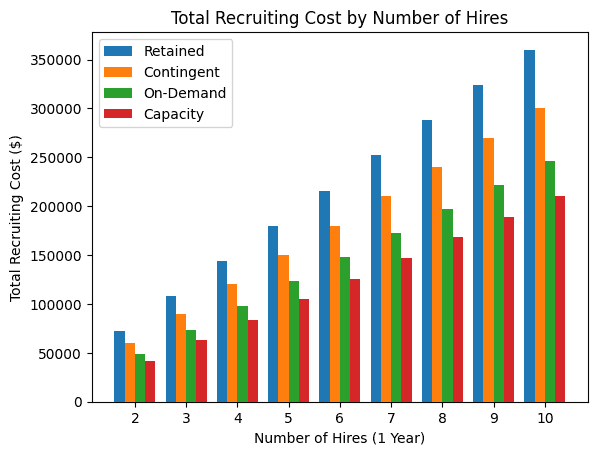
Differences in fee structure compound at an accelerating rate.
What The Chart Shows
- At 2 hires → cost differences are modest
- At 5–10 hires → differences become significant
- Coordination complexity increases with each additional search
The issue is not just cost, it’s how cost behaves over time.
The Problem Isn’t the Search—It’s the Structure
Organizations don’t struggle to find recruiting firms or executive search services.
They struggle with continuity.
Each new search introduces:
- a new process
- a new timeline
- a new ramp-up period
The result:
- duplicated effort
- inconsistent pipelines
- variability in outcomes
Not because firms are ineffective, but because the model itself is reset-based rather than structured around continuous recruiting capacity.
Hiring Demand vs. Recruiting Model Fit
Executive hiring demand is not smooth, it fluctuates.
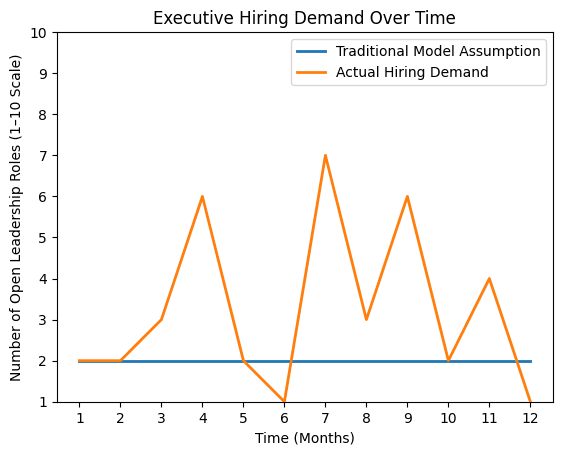
Executive hiring demand is rarely linear, yet most recruiting models assume that it is.
Capacity Changes the Model
Capacity-based executive search introduces a structural shift, not simply a pricing model.
It is core infrastructure for executive hiring.
It aligns recruiting with:
- how demand actually occurs
- how organizations scale
- how risk is managed
Instead of engaging firms per search, organizations establish:
Ongoing recruiting capacity aligned to expected hiring demand
From Reactive to Prepared
This Creates:
- Continuity across searches
- Consistency in execution
- Predictability in cost and timelines
This Shifts:
- From:
- Initiating Searches in traditional models
- hiring begins when the need appears
- To:
- Maintaining Readiness in a capacity-based model
- the system is already in motion
This Allows:
- Organizations to:
- respond faster to unplanned turnover
- support multiple concurrent searches
- reduce reliance on multiple firms
- maintain a consistent pipeline
When Capacity Becomes Necessary
Capacity becomes critical when:
- hiring is ongoing or multi-role
- leadership needs are unpredictable
- growth or restructuring is active
- timing matters as much as quality
In these environments:
Hiring is not an event—it is a continuous function.
Real-World Application
Capacity-based executive search is most effective in environments where hiring is a strategic initiative, particularly when organizations are navigating uncertainty, new funding, rapid growth, or M&A activity.
At Annuisource®, this approach is structured as defined recruiting capacity through our Annual Recruiting Partnership, aligned to anticipated leadership hiring needs across finance, accounting, HR, and operations.
Rather than initiating searches one at a time, organizations maintain ongoing recruiting support, enabling continuity, faster response times, and more consistent outcomes across multiple hires.
Capacity does not eliminate uncertainty.
It prepares for it.
Frequently Asked Questions
What is capacity-based executive search?
Capacity-based executive search is an approach where organizations establish ongoing recruiting support aligned to anticipated hiring demand, rather than engaging firms on a per-search basis. It is designed to provide continuity, consistency, and predictable outcomes across multiple hires.
How does capacity-based executive search differ from traditional executive search?
Traditional executive search is typically initiated when a role opens and is managed on a per-search basis. Capacity-based executive search, by contrast, maintains continuous recruiting support, enabling organizations to respond to hiring needs as they arise without restarting the process each time.
When does capacity-based executive search make sense?
It is most effective in environments where hiring demand is ongoing, overlapping, or unpredictable—such as periods of growth, restructuring, or leadership transition.
Is capacity-based executive search more cost-effective than retained or contingent search?
While individual searches may appear comparable, capacity-based executive search often leads to lower overall cost per hire as hiring volume increases, due to greater efficiency and reduced duplication of effort.
Does capacity-based executive search replace traditional executive search?
No. It is better understood as a structural evolution—aligning recruiting with how hiring demand actually occurs, rather than replacing the underlying search function.
How do companies choose between retained, contingent, and capacity-based executive search?
Companies typically choose between recruiting models based on hiring volume, urgency, and predictability of demand.
- Retained search is often used for high-priority, single-role searches requiring dedicated focus.
- Contingent search is more flexible but can introduce variability in candidate quality and timelines.
- Capacity-based Executive Search is best suited for organizations with ongoing or overlapping hiring needs, where continuity, speed, and cost predictability become more important over time. For a more detailed breakdown, see our executive search FAQ.